Two Perfect Bands
Bon Scott’s AC/DC, Roth’s Van Halen and the Pure Distillation of Rock and Roll
By Michael Borden·October 14, 2026·18 min read
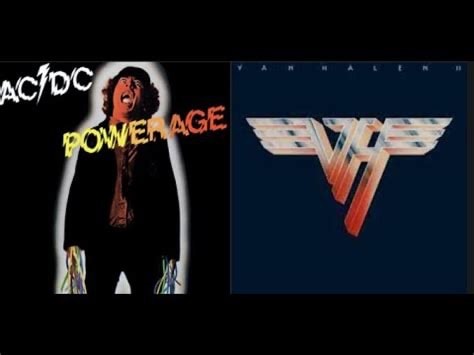
Two Perfect Bands: Bon Scott’s AC/DC and Roth’s Van Halen
If you wanted to explain rock and roll to someone who had never heard it, you could do worse than to hand them two stacks of records: the albums AC/DC made with Bon Scott between 1975 and 1979, and the albums Van Halen made with David Lee Roth between 1978 and 1984. Between them, they contain everything the music is supposed to be.
Two runs, two endings
Both stories are short, and both end abruptly.
Bon Scott sang on AC/DC’s first seven albums: the Australian-only High Voltage and T.N.T. (both 1975), the first international High Voltage (1976), Dirty Deeds Done Dirt Cheap (1976), Let There Be Rock (1977), Powerage (1978) and Highway to Hell (1979). There was also a live album, If You Want Blood You’ve Got It (1978), the only one released in his lifetime. Highway to Hell reached the top twenty in the United States and was the band’s commercial breakthrough. Then, on February 19, 1980, Bon Scott died in London at thirty-three.
David Lee Roth sang on Van Halen’s first six albums: Van Halen (1978), Van Halen II (1979), Women and Children First (1980), Fair Warning (1981), Diver Down (1982) and 1984 (1984). 1984 was the band’s commercial pinnacle, and its lead single, “Jump,” became their first and only No. 1 pop hit. Then, in 1985, Roth left.
Both bands went on to enormous success afterward: AC/DC with Brian Johnson and Back in Black, Van Halen with Sammy Hagar and four straight No. 1 albums. Those later eras deserve their own respect, and this site has argued for Van Hagar elsewhere. But there is something about these first two runs, the Scott years and the Roth years, that stands apart: a sense of a band and a frontman in perfect alignment, making music that could not have been made by anyone else, at any other time.
What rock and roll is
What does it mean to call these bands the pure distillation of rock and roll? Strip the music down to its essentials and you find a short list: a riff you can’t shake, a rhythm that moves your body, a lead guitar that thrills, a singer who embodies danger and fun at once, and lyrics about sex, freedom, trouble and having a good time. No pretension, no concept, no lecture. Short songs that hit hard and get out. Both bands had all of it.
The riffs. Malcolm and Angus Young wrote riffs of almost brutal simplicity — “T.N.T.,” “Let There Be Rock,” “Whole Lotta Rosie,” “Highway to Hell” — built on a handful of chords played with enormous power and swing. Eddie Van Halen’s riffs were more intricate — “Ain’t Talkin’ ’bout Love,” “Unchained,” “Mean Street,” “Hot for Teacher” — but just as catchy and just as physical. In both cases, the riff was the song’s engine.
The rhythm. Underneath the guitar heroes were rhythm sections built for groove. AC/DC’s Malcolm Young, the band’s backbone, with drummer Phil Rudd and bassist Cliff Williams locked in a swinging, unstoppable pocket. Van Halen had Alex Van Halen’s thunderous, swinging drums and Michael Anthony’s bass and soaring high harmonies. Both bands could make you move.
The lead guitar. Angus Young in his schoolboy uniform, duck-walking and convulsing, playing raw, blues-drenched solos at blistering speed. Eddie Van Halen reinventing the electric guitar itself, popularizing two-handed tapping with “Eruption,” widely regarded as one of the greatest guitar solos of all time. Two of the most exciting lead guitarists in rock history, in two of the most exciting bands.
The frontman. And above all, the singers. Bon Scott was a streetwise, sly, swaggering rogue, a working-class poet of lust, booze and trouble, singing with a raspy, knowing grin. David Lee Roth was a showman, a wisecracking, high-kicking ringmaster, part rock star, part vaudevillian, part stand-up comic. Both men made danger sound like fun and fun sound a little dangerous. Ted Templeman, Van Halen’s producer, described the sound he was after as “heavy-metal-with-a-smile.” That phrase describes Bon’s AC/DC just as well.
Made fast, made live
Both bands made their records the way rock and roll was meant to be made: quickly, live and with almost no fuss.
AC/DC’s albums with Scott were produced by Harry Vanda and George Young, Malcolm and Angus’s older brother, the team behind the 1960s Australian band the Easybeats. They were crucial in developing AC/DC’s sound. Their philosophy was simple: “if you got a good rhythm track, you’ve got the beginnings of a record.” Vanda and Young produced every AC/DC record up to Powerage and If You Want Blood, before Robert John “Mutt” Lange, a perfectionist who pushed Scott to find new melodies, produced Highway to Hell.
Van Halen worked with Ted Templeman, who signed them to Warner Bros. after seeing them play the Starwood in Hollywood in 1977. They recorded their debut at Sunset Sound in about three weeks, with little overdubbing or double tracking. Van Halen II was recorded in a week in December 1978, starting just seven days after the band finished its first world tour. Even Eddie’s legendary “Eruption” made the debut almost by accident: Templeman overheard Eddie warming up with it for a club date at the Whisky a Go Go and decided it had to be on the record.
That speed is not a weakness. It is the source of the music’s energy. These records sound like bands playing together in a room, with all the swagger and spontaneity of a great live show.
Bon Scott’s AC/DC
The High Voltage and T.N.T. era (1975–76). The early records are raw, rough-edged and hungry: “It’s a Long Way to the Top (If You Wanna Rock ’n’ Roll),” with its bagpipes, “T.N.T.,” “The Jack,” “Live Wire,” “High Voltage” and “Rock ’n’ Roll Singer.” Even in their earliest form, the band’s identity was complete.
Dirty Deeds Done Dirt Cheap (1976). The title track, “Problem Child,” “Ride On,” a slow, aching blues that showed Scott’s depth, and “Big Balls,” his bawdiest joke. The band’s personality — sly, nasty and funny — came into full focus.
Let There Be Rock (1977). A ferocious, kick-down-the-doors record: “Whole Lotta Rosie,” “Bad Boy Boogie,” “Hell Ain’t a Bad Place to Be,” “Dog Eat Dog” and the title track, a mock-biblical history of rock itself. The band at its rawest and most powerful.
Powerage (1978). For many devoted fans, AC/DC’s greatest album. Its groove is deeper, its songs more sophisticated: “Sin City,” “Gone Shootin’,” “Riff Raff,” “Down Payment Blues,” “Rock ’n’ Roll Damnation.” On Powerage, AC/DC were still a club band at heart. Tellingly, both Keith Richards and Eddie Van Halen have cited it as their favorite AC/DC record. The connection between our two bands is right there.
Highway to Hell (1979). With Mutt Lange’s sharper production, the band’s breakthrough: the title track, “Girls Got Rhythm,” “Touch Too Much,” “Shot Down in Flames,” “Walk All Over You,” “If You Want Blood (You’ve Got It)” and the closing “Night Prowler.” Twelve days before his death, Scott performed “Touch Too Much” with the band on Top of the Pops. It was his last great album, and it holds up from first track to last.
There is barely a weak song in the whole run.
David Lee Roth’s Van Halen
Van Halen (1978). One of the greatest debut albums in rock history: “Runnin’ with the Devil,” “Eruption,” “You Really Got Me,” “Ain’t Talkin’ ’bout Love,” “I’m the One,” “Jamie’s Cryin’,” “Atomic Punk,” “Feel Your Love Tonight,” “Little Dreamer,” “Ice Cream Man” and “On Fire.” Every song is a keeper.
Van Halen II (1979). Recorded in a week, and full of joy: “Dance the Night Away,” “Beautiful Girls,” “Somebody Get Me a Doctor,” “Light Up the Sky,” “Outta Love Again,” “D.O.A.” and Eddie’s acoustic showcase “Spanish Fly.”
Women and Children First (1980). Darker and heavier: “And the Cradle Will Rock…,” “Everybody Wants Some!!” “Romeo Delight,” “Fools,” “Loss of Control” and “Take Your Whiskey Home.” Kerrang! and Rolling Stone have both ranked it among the greatest metal albums ever made.
Fair Warning (1981). The band’s darkest, most intense record, and for many fans their masterpiece: “Mean Street,” “Unchained,” “Dirty Movies,” “Sinner’s Swing!” and “So This Is Love?”
Diver Down (1982). The most uneven of the six on paper, built partly on covers and short interludes. But even here, the band’s spirit shines: their versions of “(Oh) Pretty Woman,” “Dancing in the Street” and “Where Have All the Good Times Gone!” are full of personality, and “Hang ’Em High,” “Little Guitars” and “Secrets” are among their finest originals.
1984 (1984). The commercial pinnacle, recorded at Eddie’s new 5150 studio, with keyboards used prominently for the first time: “Jump,” “Panama,” “Hot for Teacher,” “I’ll Wait,” “Drop Dead Legs,” “Top Jimmy” and “Girl Gone Bad.” A perfect ending.
Six albums in six years, and the worst of them, by common consent Diver Down, would be the best album in many bands’ catalogs.
Why these two, and why together
Why compare them? Because they are, in a sense, two halves of the same idea, approached from opposite directions.
AC/DC came from the working-class pubs of Australia and Britain, and their rock and roll was stripped to the bone: blues-based, gritty, minimal, relentless. Van Halen came from the sunny suburbs of Pasadena and the clubs of Los Angeles, and their rock and roll was flashier, more virtuosic, more Technicolor. But both bands were built on the same foundations: riffs, rhythm, a great lead guitarist, a charismatic and funny frontman, songs about sex and freedom and trouble, and records made fast and loud.
Both bands also refused to change for the sake of trends. AC/DC ignored punk and disco and kept playing their brand of rock. Van Halen arrived at the height of disco and punk and made the electric guitar exciting again. Neither ever pretended to be anything but what they were.
And both runs ended at the moment of their greatest success, cut off by a death and a departure. Neither had time to make a weak record.
Still the standard
Nearly half a century later, these records remain the standard against which rock and roll is measured. Their songs are still played on the radio, in stadiums, in bars and in bedrooms, by teenagers picking up guitars for the first time. Countless bands have tried to capture what they had. Few have come close.
What they had was not complexity, ambition or innovation, though Eddie Van Halen innovated more than most guitarists who ever lived. It was something simpler and rarer: the spirit of rock and roll itself, captured at full strength, record after record, song after song.
That is the real achievement. Many bands have made a great album or two. Bon Scott’s AC/DC and David Lee Roth’s Van Halen made nothing but great albums. Put on any one of them, at any track, and you will hear the reason rock and roll exists.
Essential: Bon Scott’s AC/DC
- “It’s a Long Way to the Top”
- “T.N.T.”
- “Whole Lotta Rosie”
- “Let There Be Rock”
- “Sin City”
- “Riff Raff”
- “Ride On”
- “Highway to Hell”
- “Touch Too Much”
Essential: David Lee Roth’s Van Halen
- “Runnin’ with the Devil”
- “Eruption”
- “Ain’t Talkin’ ’bout Love”
- “Dance the Night Away”
- “And the Cradle Will Rock…”
- “Unchained”
- “Mean Street”
- “Hang ’Em High”
- “Panama”
- “Hot for Teacher”
Sources
The views expressed in this article are those of the author and do not constitute fact, professional advice, or the position of any third party. Mythic Heavy LLC makes no warranty as to the accuracy of any statement or claim contained herein. Where this article references substance use or personal struggles, such references are drawn solely from statements made publicly by the individuals concerned. The authors of Mythic Heavy make no allegations against any person discussed on this site.