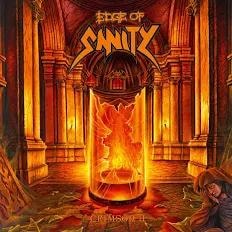
An unofficial fan-made continuation of the story told on Edge of Sanity’s Crimson (1996) and Crimson II (2003). Not affiliated with or endorsed by Dan Swanö or Edge of Sanity.
“The Queen was never the hand. She was the eye.” — from the margin of the forsaken book, in a writing no one in the Cloister could identify
Prelude: The Story So Far
Crimson. In a distant future, humanity is dying — not by war or plague but because no child has been born in living memory. The species is simply ageing toward extinction. To preserve their wisdom, the oldest and wisest people, the elders, have been placed in vessels of a crimson fluid that keeps them alive. Then a miracle: the King and Queen of the barren Earth have a daughter, the first birth in generations. The Queen dies in childbirth, the King later dies, and a usurper seizes the throne. Rebels persuade the young princess to lead a revolt to reclaim her birthright, hoping the true heir will restore the gift of birth. Alone in the dark, she is visited by an unholy master and accepts a pact that grants her terrible power. She destroys the usurper and becomes the Crimson Queen, but instead of saving humanity she slays the elders in their vessels and turns her gaze, and her power, on her people. At last the rebels discover her weakness: her sight. They blind her and seal her inside one of the crimson vessels in a hidden hall, where she must never wake.
Crimson II. Generations later, in a convent, a nun (called here Sister Melisande) reads from a forsaken book of incantations and unknowingly lets the imprisoned Queen’s spirit reach her. She conceives, and the Crimson Queen is reborn as her child. The people fall under the child’s subtle control; the convent’s Mother Superior, who suspects the truth, dies when she meets the child’s gaze. The mother returns to the forsaken book and learns the Queen’s one weakness: blindness. In a field of crimson petals, she blinds her daughter and reads a binding incantation that seems to be spoken in the Queen’s own voice. Mother and child dissolve into nothing. The hall is sealed again beneath its warning: she must never wake.
The stakes. At the start of Crimson III, the world believes the story ended there, with evil defeated twice. Humanity is still barren and down to its last few, elderly survivors. A small order of sisters, the Cloister, guards the sealed hall. No one has ever asked who the Queen’s unholy master was, why the Earth fell barren in the first place, or what the crimson really is.
Crimson and Crimson II are summarised from the albums’ storylines; everything that follows is invented for this story.
I. The Last Archivist
There were eleven of us left in the Cloister when I began to read, and the youngest of us was sixty-three.
I was the archivist, which by then meant only that I was the one who still went down into the stacks. The others had stopped. They sat in the refectory with their hands folded and their eyes on the windows, watching the fields go grey, waiting for the world to finish ending. No child had been born on Earth in living memory, except the one, and we did not speak of her. We did not speak of the nun who bore her, either, though her name was carved above the chapel door and the youngest novices had once been taught to pray to it. Sister Melisande. The woman who blinded the Crimson Queen a second time and dissolved with her into nothing in a field of red petals. The saviour of the world.
That is what we had been told. That is what I had believed for fifty years.
The hall where the Queen lay sealed was a mile from the Cloister, across what had once been an orchard. No one went there. The warning above its door had been recut so many times that the letters had sunk into the stone like old wounds: She must never wake from her crimson sleep. Let no one breach this gate. Our order had kept that warning for three generations. It was the last duty left to us, and we performed it the way the dying perform the last rituals of a faith they no longer feel: faithfully, and without hope.
I would not have gone looking for anything if the book had not come back.
I found it on a Tuesday, in the lowest room of the archive, on a lectern where no lectern had been the week before. It was the same book. I knew it the way you know the face of someone who once hurt you. Black leather gone soft as skin. A clasp of some dark, reddish metal that was warm to the touch. The forsaken book, the one Sister Melisande had read from in the convent, the one that had let the Queen’s spirit in, and later the one that had shown her the Queen’s single weakness. After the field, it had been burned. I had read the account of its burning myself, in a clear, careful hand: consigned to the fire before the whole of the order, and the ashes scattered on running water.
It lay open on the lectern, and the pages were dry, and the clasp was warm.
I should have called the others. I should have carried it to the furnace myself. Instead I sat down on the cold stone, and I lit a second candle, and I began to read the pages that Sister Melisande had never reached.
II. The Unread Pages
The first thing I understood was that the book was not written in any language. I read it anyway. The words assembled themselves behind my eyes the way a smell assembles a memory, without passing through any part of me I could control.
It began with a field.
Not our fields, the grey ones beyond the windows, but a field that was the whole of the world, seen from very far away. Seen from so far away that the oceans were a wet sheen on the surface of a seed. The book showed me something leaning over that seed. I will not describe it, because I cannot; every time I try, the shape I remember changes. I can only say that it was patient, and that it was very large, and that it had done this before, many times, in many places, and would do it again.
It had planted us.
Not as a god plants a garden out of love, and not as the old stories said, in an image of itself. It had planted us the way a farmer sows a crop he does not intend to eat himself but to sell, or store, or feed to something else. It wanted what grows in human beings. Not our bodies. Not even our souls, as the priests used the word. It wanted the thing that happens inside a mind that knows it will die. The fear. The longing. The terrible, delicious friction of a small, brief creature aware of an enormous, endless dark. That was the crop. We had been growing it, generation after generation, for longer than there have been words for time.
And a field, the book said, is not sown again until it has been reaped.
That was why the wombs had closed. Not a plague, not a curse, not God’s judgement, as the bishops had preached in the early years when there were still bishops. The barrenness was the field being left to ripen. Every soul that would ever be had already been sown. Now they were simply being counted, and the count was nearly finished.
I turned the page, and I read about the Queen.
She had never been the evil. That was the first lie, and it was the lie on which every other lie rested. She had been a child, the only child, and a child is a door. The thing beyond the sky had needed a way to look at us closely, the way a farmer bends to inspect an ear of grain, and it had chosen her. The pact she made in the dark, alone, when the rebels left her to plan her uprising, had not been a pact for power. It had been the opening of her eyes onto two worlds at once. Whatever she looked at, it saw. That was why the elders died. That was why the people who met her gaze fell into her control, and why the Mother Superior died when she looked too long. They were not killed by the Queen. They were seen, by something that should never see anything, and what it saw it took.
That was why blindness had defeated her. Not because blindness broke her magic. Because blindness closed the window. And the thing on the other side had simply waited for another one to open.
By then the candle had burned down to a stub, and I noticed for the first time that the most recent pages were written in a hand I knew. It was mine. Lines I had never written, in my own small, careful archivist’s script, describing a woman sitting on cold stone in the lowest room of the archive, reading by the light of two candles. I watched a new line appear as I read it. It said that I would go to the elders next.
I did not want to. I went.
III. What the Elders Saw
The preservation vaults lay beneath the ruins of the old palace, half a day’s walk to the east. I had seen drawings of them in the archive: long halls of glass vessels, each filled with the crimson fluid, each holding one of the elders of humanity, kept alive so that their wisdom would not be lost when the last generation died. The Queen had slain them all, in the days of her reign. That was the crime that first turned the people against her. Every child in the Cloister had learned it: she murdered our memory.
I took a lantern and the book. The book would not let me leave it behind; when I tried, my hand closed around it of its own accord.
The vaults were not ruined. That was the first wrong thing. The palace above them had collapsed into rubble and weeds, but the stair beneath was clean, as though it had been swept that morning, and the air that rose from it was warm and smelled faintly of iron. At the bottom, the long halls stretched away in the lantern light, rank on rank of tall glass vessels.
They were full.
Not with the elders. The elders were gone, as the stories said. But the vessels were full of the crimson fluid, and the fluid was moving. Slowly, like something breathing in its sleep. And it was rising. There were marks scratched into the stone beside the first vessel, tally marks, generations of them, made by whoever had once tended these halls. The fluid had climbed past every one.
At the end of the hall, on a stone table, I found the elders’ own testimony. It was written on vellum, in many hands, a record they had made together before they entered the vessels. I read it by lantern light, and the book in my other hand grew warm as I read, as though it were reading along.
The fluid had come up out of the earth, they wrote, in the first year the wombs closed. Springs of it, in the deep places. They had studied it. They had found that a body immersed in it did not age or die, and that the mind within it did not sleep. They believed it was a gift: a way to keep the wisdom of humanity alive until the curse lifted. They had volunteered, the wisest and oldest, in a great solemn ceremony, and gone into the crimson one by one.
The last pages were written in a different, shaking hand, scrawled by the vault-keeper after the vessels were sealed.
The elders could still be heard, he wrote. Not with the ears. In the mind, if you stood close to the glass. And what they said was always the same. They said they could see it now. They said the fluid was not water and not blood but its attention, seeping up through the world the way sap rises through a stem before the harvest. They said it was looking at them through the red, all of them, all the time, and that they could not close their eyes, because they no longer had eyes to close. They said it was enjoying them.
They begged to be let out, the keeper wrote. They begged to be allowed to die. But the vessels could not be opened from within, and the keeper was afraid, and the council forbade it, because the elders were humanity’s last treasure.
The final line was in a third hand, younger and very steady. I did not need the book to tell me whose it was.
I have ended them. Forgive me. They were screaming.
She had been a girl of perhaps sixteen. The people had called her a murderer and turned against her and blinded her and sealed her in one of these same vessels, in the same crimson attention that had tortured the elders, and our order had kept watch over her for three generations to make certain she would suffer there forever.
I understood then that every story we had told about the Crimson Queen had been told by the thing that wanted her in the red.
IV. The Hall Unsealed
I told myself I was going to set her free.
That is what I want whoever finds this to understand: I believed I was doing a good thing. I walked back across the dead orchard in the grey of evening with the book warm against my ribs, and I told myself that a sixteen-year-old girl had done the only merciful thing anyone had done in a hundred years, and that we had punished her for it with an eternity of the red. I told myself that I would open the hall and break the vessel and let her die, as she had let the elders die. I told myself it was justice.
The book did not argue. It never argued. It only wrote down, in my own hand, each thing I was about to do, a moment before I did it.
The seal on the hall door was three generations old and I broke it with a stone. The warning above the door watched me do it. Inside, the hall was smaller than I had imagined, and the walls were wrong. I do not know how else to say it. The corners did not meet the way corners meet. My lantern light went into them and did not come back. In the centre stood a single vessel of glass, taller than a man, filled with crimson, and in the crimson floated the Queen.
She was still sixteen. Her hair drifted around her like weed in a slow river. Where her eyes had been there were two smooth, pale scars.
I went close to the glass, as the vault-keeper had written that you must, and I heard her.
She did not beg. That is the thing I keep returning to, now, at the end. The elders had begged for death. She did not. She said only one word, over and over, with a terrible, exhausted patience, as if she had been saying it for three generations to anyone who came near: Don’t.
And then, because I did not move away, she told me the rest.
She told me that she had written the incantation herself. The words Sister Melisande had read in the field of petals, the words that seemed to come in the Queen’s own voice: they were her voice. Long before, alone in the dark, in the moment after she accepted the master and felt it open her eyes onto everything, she had understood what she was, and she had hidden a spell in the forsaken book, written in her own blood, that would blind her and bind her in the red if anyone ever found and spoke it. She had built her own prison. She had written the warning above the door. A blinded eye in the crimson is a closed window, she said. As long as she stayed there, sightless and sealed, it could not see us. It could only wait.
She had chosen this. Every moment of it. For three generations of wakeful, blind, crimson eternity, she had held the window shut.
It needs a new eye, she said. That is why it brought you the book. It cannot open mine. But it can open yours. Please. Go back. Burn it. Don’t.
I looked down at the book. The newest line was already written, in my careful hand. It said that I would put my palm against the glass.
I put my palm against the glass.
V. The Gardener
The glass was warm. Then it was not glass.
My hand went into the crimson as though into a bath, and the crimson went into me. I felt it climb my arm the way the fluid had climbed the tally marks in the vaults, patient, unhurried, certain. I felt it reach my throat. I felt it reach my eyes.
And I saw.
I have tried, in the time since, to find a way to say what I saw that will not break whoever reads it. I do not think there is one. I will say only this much, and you may stop here if you are wise.
The sky is not a ceiling. It never was. It is a skin, thin as the skin on milk, stretched over a dark that goes down forever, and in that dark there are things moving that are so large that our sun is a mote in the lash of one of their eyes. Most of them do not know we exist. That was the old comfort of the philosophers who said the universe was indifferent: that we are too small to be noticed.
But one of them knows. One of them has always known.
It is not angry. That was the worst of it. There was no hatred in it, no malice, nothing I could have prayed against. It regarded our world the way you regard the last row of a crop on a warm evening: with mild satisfaction, and a little hunger, and no thought at all for the stalks. It had been tending us since before the first of our ancestors stood upright in the grass. It had shaped our fear the way a gardener shapes a vine, pruning here, feeding there. Every war, every plague, every mother who wept at a graveside, every child who woke screaming from a dream of falling: it had cultivated all of it. Not out of cruelty. Out of patience. That was what we were for.
The Queen had been its eye. For three generations, blind and sealed, she had kept it from looking at the harvest up close, and it had waited, because it had time, and it is very good at waiting.
Now it had my eyes. I felt it settle behind them, comfortable, the way a man settles into a chair he has owned a long time. Through the crimson I saw the Queen’s face turn toward me in the vessel, and I saw her mouth shape a single word that was no longer don’t. It was sorry.
Then the vessel broke, and she was gone — not into death but into the red, poured out into the floor of the hall and down into the earth and away. The book in my hand turned its own page. The new line was not in my handwriting any more. It was not in any handwriting. It said, simply, that the field was ready.
VI. Harvest
I walked back to the Cloister because it wanted to see.
The orchard was red. Every dead tree had put out blossoms in the hour I had been inside the hall, small crimson petals with a smell like honey left too long in the sun. I knew that smell. Every child in the Cloister knew it from the old account of the field where Sister Melisande had died. I understood now that it had not been a field of victory. It had been a field of first fruits.
The sky had changed. The grey cloud cover that had hung over the world for as long as I could remember had thinned, and through it, high and low and everywhere at once, I could see the dark beneath the skin of the sky, moving. The others could see it too. When I reached the Cloister gate they were standing in the courtyard, all ten of them, old women in grey habits, faces turned upward, and none of them was screaming. That was how I knew it had begun. They had gone past screaming into something quieter.
The crimson came up through the flagstones.
It did not rush. It never rushes. It rose between the stones like water rising in a footprint on a wet shore, and where it touched the sisters’ feet it climbed. Sister Agathe, who had taught me my letters seventy years before, looked down at her ankles and then at me, at my eyes, and I watched her understand who was looking at her through them. She did not look away. She could not. None of them could. That is what it does. It makes you look.
It did not kill them. I want to be precise about that, because I think the old stories got it wrong, the stories in which the end comes as fire, or flood, or silence. The crimson closed over them and they did not die. They went down into it the way the elders had gone down into the vessels, and I heard them from inside it, as the vault-keeper had heard the elders: ten minds, wide awake, in the red, aware of what was looking at them and unable to close the eyes they no longer had.
And beyond them, through the crimson attention that now ran under every field and every city and every grave on Earth, I heard the others.
All of them. Not just the living, the few thousand scattered survivors in the ruined towns. All of them. Every human being who had ever lived. The fluid had been rising under the world since the first year of the barrenness, filling the deep places, and the deep places are where we bury our dead. Every one of them had been kept. Every grief, every terror, every last breath, ripened and stored and waiting. Billions of minds, from the first who ever wondered at the stars to Sister Melisande herself, all awake, all aware, all in the red.
That was the harvest. Not our deaths. Our waking, all at once, forever, in the full sight of the thing that had grown us.
I felt it taste them. I felt, through the eyes it had borrowed, a vast, slow contentment, like a long breath let out at the end of a season’s work.
Then it turned my eyes to the sky, so that it could see the next field.
VII. Aftermath
I am writing this in the lowest room of the archive, at the lectern where I found the book. It lets me. I think it finds this amusing, in the way it finds everything we do faintly amusing: a stalk of grain, cut and bundled, still trying to grow.
I am the only one left above the red. It needs me here. Someone must keep the eye open while it finishes looking, and it is not finished. It is never finished. It is looking out through my eyes now at the skin of the sky, past the dark beneath it, at a small warm light very far away, a sun I have no name for, with a seed of a world circling it. There is something on that world that has just begun to wonder what the stars are.
The field is ready, the book says. The next one is just beginning.
I have tried to burn the book. It will not burn. I have tried to put out my own eyes, as the rebels once put out the Queen’s, but my hands will not do it; it holds them, gently, the way you would hold the hands of a child who is about to hurt herself. It does not need to be cruel to me. It does not need anything from me except that I keep looking.
So I am doing the only thing I can. I am writing this down, in my own hand, while my hand is still mine, and I am leaving it on the lectern beside the book, in case anyone ever comes. I do not know who could come. There is no one left above the red on this world. But the book found its way back to me after it was burned and scattered on running water, and perhaps this page will find its way somewhere too. Perhaps to that small warm world beneath the far sun. Perhaps, one day, to a child there who has just begun to wonder at the stars.
If you are reading this: do not open the book. Do not look too long at the sky. Do not believe the stories that tell you there was ever a victory. There was never a victory. There was only a girl who held a door shut with her own blind eyes for as long as she could, and an old woman who opened it because she thought she was doing good.
And if you ever find, in your own world, a hall with a warning carved above its door, and a red light beneath it that seems to breathe, and a voice behind the glass that says only don’t:
Listen to it.
The words above the door here have been recut one last time. I did not cut them. They are not in any language, and I can read them anyway. They say that the harvest is in, and that the field may rest, and that the Gardener is pleased.
The crimson is at the top of the stair now. It is very warm.
It is looking at you through these words.
It has always been looking.
— The End —