Beyond the Riff
Deep Time: Heavy Music, Geology, and the Weight of the Earth
Heavy music has always borrowed its language from the ground beneath our feet: metal, stone, iron, lead, mountains, magma. This is an essay about why.
A word from the periodic table
Start with the name. Before it was a genre, "heavy metal" was a term from chemistry and metallurgy, referring to the weight of certain metals. One history of the phrase traces its technical birth to 1839. It was also a military term for heavily armored tanks and guns. Then it entered literature: William S. Burroughs used it in his 1961 novel The Soft Machine, naming a character "the Heavy Metal Kid," and it entered music through Steppenwolf's "Born to Be Wild" (1968), with its famous line about heavy metal thunder. The critic Lester Bangs was among the first to apply the term to the sound of Black Sabbath.
The metaphor stuck because it fit. Heavy metals are dense, dark and dangerous; they are dug from deep in the earth, refined in fire, and in many forms toxic. The music that took their name is dense, dark and dangerous too.
And its birthplace makes the point concrete. Black Sabbath, generally accepted as the first heavy metal band, came from Birmingham, which was then a major center of metal goods manufacturing in Britain. Birmingham was among the first industrial cities in the world, its industry centered on the factories and furnaces of the region known as the Black Country, which a nineteenth-century American consul described as black by day and red by night. Before they were Black Sabbath, the band called themselves Earth. The first heavy band, from the heart of metal country, began by naming itself after the planet.
Why heavy music sounds like geology
There is a reason these metaphors feel natural. Heavy music, at its most powerful, behaves like geological force.
It is slow. The great doom and sludge bands move at the pace of continents. A riff by Sleep or Electric Wizard doesn't race; it grinds, repeating and accumulating until it becomes overwhelming, like the slow, relentless pressure of tectonic plates pushing against each other over millions of years.
It is built on pressure. The most crushing moments in heavy music come after long buildups of tension, quiet passages that strain toward release. That is how earthquakes work: stress accumulating along a fault line until the rock finally gives way. Neurosis, Isis and Cult of Luna built entire careers on that pattern of slow strain and sudden rupture.
It is low. Heavy music lives in the lowest frequencies, down-tuned guitars and rumbling bass that you feel in your chest as much as hear. Tony Iommi's decision to tune down on Master of Reality gave rock a sound like the earth groaning. Earthquakes, too, produce sound below the threshold of hearing, a rumble felt in the body.
It is vast. The best heavy music suggests enormous scale, sounds that feel older and larger than the people making them. Geology deals in deep time, the billions of years over which mountains rise and wear away. Heavy music reaches for the same sense of something immense and indifferent.
Mastodon: the elements
No band has made the earth more central than Mastodon. Their early albums were loosely organized around the classical elements: fire on Remission (2002), water on Leviathan (2004), earth on Blood Mountain (2006) and aether, the element of the sky and spirit, on Crack the Skye (2009). Blood Mountain, their earth album, tells of a climber's journey up a mythical peak in search of a crystal skull. The mountain is both a physical and a spiritual obstacle, and the band's dense, intricate riffs seem to carve paths through rock.
The band's very name evokes the earth's deep past: the mastodon, an extinct relative of the elephant, known to us through its fossils.
The desert: Kyuss and the stoner rock bands
Kyuss came from the high desert of Palm Desert, California, where they played generator-powered parties in the open air, under the stars, surrounded by rock and sand. Their sound, thick, fuzzy and hypnotic, is inseparable from that landscape. The desert is geology laid bare: stone, sand and sky, without the cover of vegetation, eroded over millions of years into strange formations. Kyuss's music sounds like that: vast, dry, sun-baked and timeless.
The stoner rock and doom bands who followed, from Sleep to Yawning Man to Elder, carried that sense of place with them. Sleep's Dopesmoker, a single hour-long song about a pilgrimage across a desert, is almost geological in its slowness and scale.
Drone: the band called Earth
In Seattle, in the early 1990s, Dylan Carlson took the name Black Sabbath had abandoned and called his band Earth. Its 1993 album Earth 2 is one of the founding documents of drone metal: sustained, overwhelming, slowly shifting chords that sound less like songs than like the movement of tectonic plates. Earth's influence runs through Sunn O))), whose ritualistic performances are built around sound so low and loud it is felt physically, and through the entire drone and doom underground. In this music, heaviness is not speed or aggression. It is mass.
Gojira: the planet in danger
The French band Gojira has made the earth itself a cause. Their 2005 album From Mars to Sirius is built around environmental themes, with songs about the oceans and the warming planet, and their later album Magma (2016) takes its name from the molten rock that churns beneath the crust. Gojira's music is crushing and precise, and their subject is the planet as something both overwhelmingly powerful and terribly fragile.
Neurosis: silver in blood
Neurosis's Through Silver in Blood (1996), one of the founding records of post-metal, takes its title from a precious metal, and its music feels mineral: slow, crushing, ancient and cold. Its long, grinding structures, built on repetition and slow escalation, sound like the pressure that forms rock deep underground.
Precious things from pressure
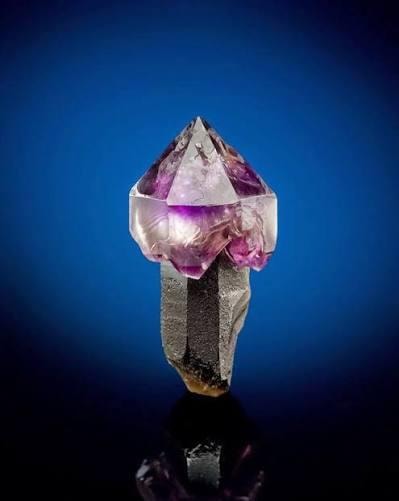
The earth's most beautiful products are born from extreme conditions. Diamonds form deep in the mantle under immense heat and pressure. Crystals grow slowly in cavities in rock over thousands or millions of years. Gold and silver are concentrated by hot fluids moving through cracks in the earth's crust. Geodes, those plain, rough stones that split open to reveal glittering interiors, are a perfect metaphor for heavy music itself: something forbidding on the outside, astonishingly beautiful within.
Heavy music is full of that duality. Death's "Crystal Mountain," from Symbolic (1995), uses the image of a crystal mountain in a song about religious hypocrisy, set to some of Chuck Schuldiner's most elegant, melodic playing. Opeth's albums, beginning with Orchid and running through Blackwater Park and beyond, alternate crushing heaviness with passages of acoustic beauty, as if splitting open a stone to reveal the crystal inside. Talk Talk's Spirit of Eden does something similar from the opposite direction: long silences that erupt into violent force.
And consider the metals that heavy bands have named themselves after. Led Zeppelin took their name from lead, the classic heavy metal; Iron Maiden and Iron Butterfly from iron; Metallica from metal itself. Megadeth's Rust in Peace (1990) took its title from the oxidation of iron, the slow, chemical decay of metal exposed to the elements. These are not accidents of naming. They are reaching for the weight, density and durability of the earth's hardest materials.
Deep time
Perhaps the deepest connection between geology and heavy music is time.
Geology confronts us with spans of time almost impossible to imagine: the four and a half billion years of the earth's history, the hundreds of millions of years over which continents drift and mountains rise and fall. Against that backdrop, human life is a flicker.
Heavy music, at its most ambitious, reaches toward that perspective. Long-form pieces like Edge of Sanity's Crimson, Sleep's Dopesmoker, Neurosis's sprawling epics and Earth's endless drones stretch time out, slow it down and make the listener feel its weight. They suggest something older and larger than any individual, a force that will continue long after we are gone. Black Sabbath's "Into the Void" imagines leaving a ruined earth behind; Gojira's music imagines the earth fighting back.
The earth is the heaviest thing we know. It is made of metal and stone, shaped by fire and pressure, ancient beyond understanding, capable of both crushing violence and extraordinary beauty. For more than half a century, heavy music has been trying to sound like it.
Essential listening
Black Sabbath, Master of Reality (1971). Earth, Earth 2 (1993). Kyuss, Welcome to Sky Valley (1994). Neurosis, Through Silver in Blood (1996). Sleep, Dopesmoker (2003). Gojira, From Mars to Sirius (2005) and Magma (2016). Mastodon, Blood Mountain (2006). Death, "Crystal Mountain" (Symbolic, 1995).