Groovy: The Bonkers Brilliance of Evil Dead II
The 1987 horror sequel that turned a cabin in the woods into a live-action Looney Tunes cartoon drenched in blood, and changed horror comedy forever.
By Ryan Montgomery·October 19, 2026·15 min read
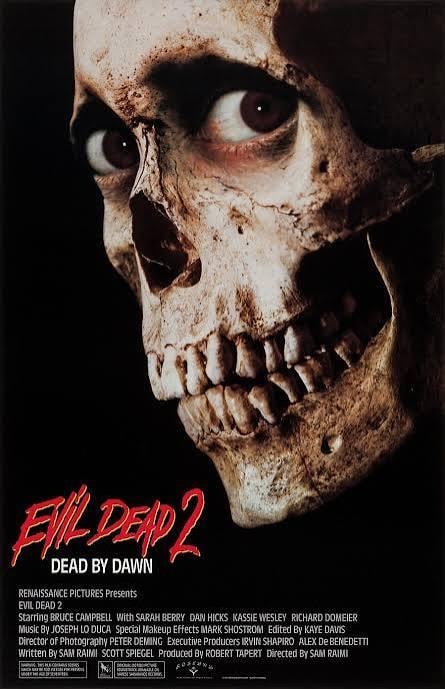
Beyond the Riff takes a second look at the films, records and ideas that shaped heavy culture. This time: the 1987 horror sequel that turned a cabin in the woods into a live-action Looney Tunes cartoon drenched in blood, and changed horror comedy forever.
A cartoon made of flesh
There is a scene in Evil Dead II where Ash Williams, played by Bruce Campbell, fights his own hand.
The hand has been possessed. It slaps him, smashes plates over his head, grabs his hair and slams his face into the floor. Campbell throws himself around the kitchen like a man being beaten up by an invisible bully, flipping over, crashing into cupboards and flailing wildly, while his own hand tries to kill him. Eventually, he cuts it off with a chainsaw. The severed hand scuttles away, flips him the bird, and hides under a bucket weighed down with a stack of books. On top of the pile, visible to the audience, is a copy of Ernest Hemingway's A Farewell to Arms.
That scene captures everything about Evil Dead II. It is horrifying. It is disgusting. And it is one of the funniest things ever put on film: a Bugs Bunny cartoon made of flesh and blood, starring a man with a chin like an anvil.
Few horror films have been as widely cited as a turning point for the genre, and fewer still have managed to be genuinely frightening and genuinely hilarious at the same time.
Part one: the cabin
To understand Evil Dead II, you have to start with the film that came before it.
Sam Raimi and Bruce Campbell grew up together in Royal Oak, Michigan, making 8mm movies with their friends. In 1980, with the producer Rob Tapert, they headed into the woods of Tennessee to make a long-gestating, low-budget horror film called The Evil Dead. It was made over several years with somewhere between $350,000 and $400,000 in piecemeal funding. The story was simple: five young people at a remote cabin unleash demons from an ancient book, and are possessed and killed one by one.
What made it extraordinary was the filmmaking. Raimi's camera seemed alive: it rushed through the woods at ground level, representing the evil force itself, in what became known as the "shaky cam." The gore was relentless, the energy frantic, and there was already a strange, slapstick sense of humor running through the terror, one that a critic described as "Three Stooges-esque."
The film got its break when the veteran producer Irvin Shapiro secured a screening at the 1982 Cannes Film Festival. There it was seen by Stephen King, who wrote a glowing review in Twilight Zone Magazine and called it "the most ferociously original horror film of the year." With that endorsement, and support from Fangoria, it found distribution through New Line Cinema and grossed eight times its budget in the United States. It became a cult classic.
Part two: a remake with a budget
After The Evil Dead, Raimi made his first studio picture, Crimewave (1985), a critical and commercial flop and a rocky experience that left him longing for the creative control of independent filmmaking. The team decided to return to the Evil Dead story.
They couldn't find funding until Stephen King stepped in again. King, then making his directorial debut, Maximum Overdrive, with the producer Dino De Laurentiis, brought the project to his attention. De Laurentiis agreed to back it with a far larger budget than the original — about $3.5 million.
Raimi had a different sequel in mind: a story that sent Ash back in time to the Middle Ages. De Laurentiis had other ideas. He wanted the new film to stay on familiar ground — the same cabin, the same Deadites, the same basic shape as the original. What he was asking for, whether he framed it that way or not, was a do-over with a real budget. (Raimi saved the medieval premise for the third film.)
There was another problem. Raimi had planned to open with footage from the original to recap the story, but the rights to the first film were held by its international distributors, and licensing the footage proved nearly impossible. So the team simply re-shot the story themselves. The first seven minutes of Evil Dead II are a streamlined retelling of the first film, with only Ash and his girlfriend Linda going to the cabin. Then, at the precise moment the original ended, the evil force grabs Ash, and the sequel begins.
The result is neither a true sequel nor a straightforward remake. It falls somewhere in between. But in practice, Evil Dead II is the story of The Evil Dead told again, by the same filmmakers, with ten times the money, far more experience and a completely different sensibility. It's a remake with a budget.
Looney Tunes with a chainsaw
That different sensibility is what makes Evil Dead II unique.
Raimi brought in his friend Scott Spiegel to co-write the script. Rather than write another straight horror film, they leaned into their lifelong love of the Three Stooges and built something that had never quite existed before: a horror film that played its violence for laughs without undercutting the dread. Another influence was Spiegel's short film Attack of the Helping Hand, in which the Hamburger Helper mascot goes on a violent rampage; it inspired the scene in which Ash fights his own hand.
The result is horror played with the physical logic of a cartoon. Bruce Campbell is thrown, slammed, spun, splattered and drenched, absorbing punishment like Wile E. Coyote. In one of the film's most famous scenes, the furniture in the cabin — a lamp, a mounted deer head, a bookcase — begins to laugh, and Ash laughs along, maniacally, as if his mind has finally snapped. In another, a wall bursts open and he is hit by a geyser of blood so enormous it nearly knocks him over. When a possessed creature declares that it will swallow his soul, Ash raises his shotgun and answers: "Swallow this." And when he straps a chainsaw to the stump of his arm and saws off the barrel of his shotgun, he looks at himself in the mirror and says, simply: "Groovy."
Raimi's camera is as wild as the action. In the film's opening, after the recap, the evil force picks Ash up and carries him through the woods, spinning him around as if on a knife thrower's wheel, an effect achieved by strapping Campbell to a constructed rig. Raimi's subjective camerawork, executed by three cinematographers, most notably Peter Deming, represents an intensely inspired combination of technical and visual flourishes. Deming went on to shoot My Cousin Vinny, David Lynch's Lost Highway and Mulholland Dr., and The Cabin in the Woods.
What makes it all work is balance. Evil Dead II is genuinely frightening, full of grotesque makeup effects, sudden shocks and an atmosphere of claustrophobic dread. But its horror and its comedy feed each other. The more terrible things get, the funnier they become, and the funnier they become, the more unsettling. No film before had done it quite this way, and few since have done it as well.
Release
Because De Laurentiis had an agreement with the MPAA that prevented him from releasing X-rated films, Raimi and his team set up a shell company, the Rosebud Releasing Corporation, to distribute the film unrated. Evil Dead II opened on Friday the 13th, March 1987, on just 310 screens. It was a minor box office success, grossing just under $6 million. But like its predecessor, it found its true audience over time and became a cult classic around the world.
The filmmakers it inspired
Few horror films have inspired so many other filmmakers.
Edgar Wright, the director of Shaun of the Dead and Hot Fuzz, has been the most direct about the debt. "Evil Dead 2 is the film that set me off on my career," he told an interviewer. Wright has described how, as a teenager in Somerset, he had assumed film directors were simply born into Hollywood — until he learned how Raimi made The Evil Dead on almost nothing, and how Evil Dead II's collision of genres opened up what he thought was possible. He has listed it among the films he has returned to most over his life. Shaun of the Dead, with its blend of terror, slapstick and gushing blood, is unthinkable without it.Its influence even reached outside horror, to Raimi's friends Joel and Ethan Coen, and it spawned a flood of imitators, including Italy's notorious La Casa series.
Army of Darkness
Evil Dead II made enough money internationally that De Laurentiis was willing to finance another sequel. Army of Darkness (1992), with a budget of $11 million, finally used Raimi's original premise, sending Ash back to the Middle Ages, where he battles an army of skeletons to retrieve the Necronomicon. Its working title was Medieval Dead.
It is a great film: funny, inventive, endlessly quotable and full of Raimi's visual flair. Bruce Campbell's Ash becomes a full-blown action hero, swaggering through scenes with one-liners that fans still recite.
But it leans much harder into comedy, adventure and fantasy, and in the process it loses the balance that made Evil Dead II so brilliant. The horror recedes; the terror becomes mostly spectacle. It is a wonderful comic fantasy film with horror elements. Evil Dead II is a horror film that happens to be hilarious. That difference is why Evil Dead II remains the masterpiece of the trilogy.
The enduring legacy
Nearly forty years later, Evil Dead II is widely regarded as one of the greatest horror sequels ever made and still the funniest horror movie ever made. Its fingerprints are all over modern horror comedy, from Shaun of the Dead to Dead Alive to The Cabin in the Woods. Raimi went on to direct the Spider-Man trilogy, but he never lost the energy and invention he displayed in that cabin. And Bruce Campbell, whose physical performance remains one of the great feats of comic acting, became a cult icon. Ash vs Evil Dead, a direct sequel to the original trilogy, ran for three seasons on Starz from 2015 to 2018.
The new Evil Dead
Remarkably, the franchise has continued to thrive, not by imitating Evil Dead II's comedy but by returning to the pure horror of the original.
Evil Dead (2013). Directed by Fede Álvarez, co-written with Rodo Sayagues, and produced by Raimi, Campbell and Tapert, this standalone sequel introduced a new protagonist, Mia, played by Jane Levy. It was brutal, terrifying and relentlessly gory, a straight horror film with almost no jokes. Made for $17 million, it grossed $97.5 million. It is a superb horror film, and proof that the franchise's core could stand on its own without Ash.
Evil Dead Rise (2023). Written and directed by Lee Cronin, it moved the Deadites from the woods to a Los Angeles apartment building, with a story about two estranged sisters and three children. Warner Bros. moved it from streaming to theaters after strong test screenings. It earned an 85% Tomatometer score and grossed about $147 million on a $15 million budget — the biggest hit in the franchise's history. It is ferocious, inventive and deeply unsettling.
Evil Dead Burn (2026). Directed by Sébastien Vaniček, the French director of the acclaimed spider-horror film Infested, and co-written with Florent Bernard, Burn was released in July 2026 as a sequel to Rise. It received generally positive reviews, with Rotten Tomatoes' consensus calling it the meanest, nastiest and ickiest chapter yet; some critics found it stronger than Rise. It grossed about $72 million on a $20 million budget — a softer result than its predecessors, but one that confirmed the franchise's creative health. A seventh film, Evil Dead Wrath, directed by Francis Galluppi, is scheduled for April 2028.
Those newer films prove something important: the Evil Dead concept is strong enough to support both straight horror and wild comedy. But none of them has tried to do what Evil Dead II did, because no one could.
Why it still matters
Evil Dead II is a one-of-a-kind film: a horror movie made by people who loved the Three Stooges and Looney Tunes as much as they loved splatter, and who found a way to combine them without losing the power of either. Its balance of terror and comedy has rarely been matched, and its influence runs through decades of horror and comedy filmmaking.
It also proves that a remake can surpass the original, when the filmmakers have something new to say. Raimi and Campbell took their own film, told it again with more money and more nerve, and made something far stranger and more wonderful.
Groovy.
Comments
Leave a comment
The views expressed in this article are those of the author and do not constitute fact, professional advice, or the position of any third party. Mythic Heavy LLC makes no warranty as to the accuracy of any statement or claim contained herein. Where this article references substance use or personal struggles, such references are drawn solely from statements made publicly by the individuals concerned. The authors of Mythic Heavy make no allegations against any person discussed on this site.