The Power of Folk Horror: How Cinema Turned Folklore Into Nightmare
From The Wicker Man to The Witch, Midsommar, The Wailing, and Hereditary — a journey through twelve of the greatest folk horror films ever made and the genre that continues to haunt modern cinema.
By Ryan Montgomery·October 12, 2026·18 min read
Imagine arriving in a place where everyone knows something you do not.
The landscape is beautiful. The community seems welcoming. The traditions appear harmless. Yet with every passing day, you become increasingly aware that the people around you are living according to rules older than anything you understand.
That is the nightmare at the heart of folk horror.
More than perhaps any other branch of horror cinema, folk horror draws its power from the conflict between modernity and tradition. It suggests that beneath contemporary life lie older beliefs, forgotten rituals, and ancient ways of understanding the world that never truly disappeared. The horror comes not from a monster hiding in the darkness but from an entire community that believes something you do not.
Although the genre's roots extend deep into folklore, literature, and early cinema, folk horror emerged most clearly as a cinematic movement in Britain during the late 1960s and early 1970s. Critics and historians frequently identify Witchfinder General (1968), The Blood on Satan's Claw (1971), and The Wicker Man (1973) as the genre's foundational "Unholy Trinity," a concept later popularized through Mark Gatiss's BBC documentary A History of Horror and subsequent scholarship.
At its core, folk horror is defined not by monsters but by landscape, isolation, belief systems, and ritual. The genre repeatedly places outsiders into communities governed by customs that seem ancient, coherent, and increasingly terrifying. These themes have been influential enough that scholars have attempted to formalize them through models such as Adam Scovell's "Folk Horror Chain," which identifies landscape, isolation, skewed belief systems, and a culminating ritual or "happening" as recurring features of the genre.
After flourishing during the 1970s, folk horror entered a quieter period before undergoing a remarkable revival during the twenty-first century. Filmmakers such as Robert Eggers, Ari Aster, Ben Wheatley, Gareth Evans, and David Bruckner reintroduced the genre to new audiences, proving that ancient fears remain surprisingly adaptable to modern anxieties.
These are twelve of the greatest folk horror films ever made, including one title whose place within the genre remains hotly debated.
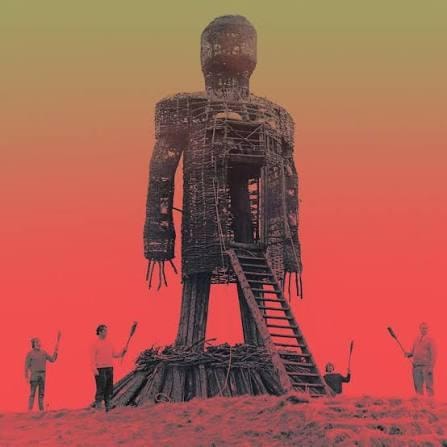
1. The Wicker Man (1973) — Director: Robin Hardy
If folk horror has a masterpiece, it is The Wicker Man.
More than any other film, Robin Hardy's extraordinary work established the blueprint for everything that followed. Its influence runs through modern horror so deeply that many viewers discovering it today may feel they have already seen parts of the story. In truth, generations of filmmakers have spent decades borrowing from it. Critics, historians, and genre scholars consistently identify it as folk horror's defining work.
The film follows Sergeant Neil Howie, a devout Christian police officer who arrives on the remote Scottish island of Summerisle to investigate the disappearance of a young girl. What begins as a missing-person case gradually transforms into something far stranger. The islanders openly celebrate pagan traditions, perform fertility rituals, and embrace a belief system fundamentally incompatible with Howie's worldview. As he continues his investigation, he finds himself increasingly isolated within a culture he cannot comprehend.
One of the film's great achievements is that it never relies upon conventional horror villains. The islanders are not obviously threatening. In many ways they seem cheerful, welcoming, and content. Yet every conversation increases the sense that something is deeply wrong. The tension comes not from violence but from incompatible systems of belief.
Christopher Lee's Lord Summerisle remains one of horror cinema's most memorable characters. Intelligent, charismatic, and utterly convinced of the righteousness of his convictions, he embodies the genre's central fear: not madness, but certainty.
For many critics, historians, and genre fans, The Wicker Man remains the greatest folk horror film ever made and the benchmark against which later entries are measured.
2. The Witch (2015) — Director: Robert Eggers
Robert Eggers' debut feature helped ignite the modern folk horror revival and established him as one of contemporary cinema's most distinctive filmmakers. The Witch quickly became a landmark horror film, praised for its historical authenticity, atmosphere, and psychological power.
Set in seventeenth-century New England, the film follows a Puritan family exiled from their settlement following a religious dispute. Forced to build a homestead beside a vast wilderness, they struggle to survive as a series of increasingly disturbing events begin to undermine their faith, family structure, and understanding of reality.
Eggers approached the project with extraordinary attention to historical detail. Dialogue was drawn from period sources, while costumes, architecture, and religious practices were reconstructed from historical records. The result is an immersive experience that places viewers inside a culture where belief in witchcraft was not superstition but a genuine explanation for misfortune and suffering.
The forest looming beyond the family's farm becomes one of the most unsettling locations in modern horror. It functions simultaneously as physical space, spiritual threat, and psychological symbol. Every trip toward the tree line feels like an approach toward the unknown.
What separates The Witch from most modern horror films is its refusal to reassure the audience. It does not examine folklore from a safe intellectual distance. Instead, it asks viewers to inhabit a worldview in which folklore may be horrifyingly true.
3. Midsommar (2019) — Director: Ari Aster
If The Wicker Man is folk horror's foundational masterpiece, Midsommar is arguably its most important modern descendant.
The film follows Dani, a young woman devastated by personal tragedy who accompanies her emotionally distant boyfriend and his friends on a trip to a remote Swedish commune. They arrive expecting a cultural festival and anthropological curiosity. What they discover is a society governed by traditions far older and more demanding than they imagined.
Ari Aster brilliantly transforms daylight into a source of terror. Unlike traditional horror films that conceal danger in darkness and shadow, Midsommar unfolds beneath endless Scandinavian sunlight. Flower-covered fields, white ceremonial garments, and picturesque landscapes become increasingly unsettling as audiences recognize what lies beneath their beauty.
At its heart, however, Midsommar is a film about grief, belonging, and emotional vulnerability. Florence Pugh gives a remarkable performance as Dani, grounding the increasingly bizarre events in genuine human pain. The cult at the center of the story offers something absent from her life: certainty, structure, and communal support.
That emotional complexity helps explain why the film remains so compelling. Like the greatest folk horror films, it forces viewers to confront an uncomfortable question: what happens when a community offering genuine belonging is also fundamentally horrifying?
4. Kill List (2011) — Director: Ben Wheatley
Ben Wheatley's Kill List is one of the most disturbing films of the twenty-first century and among the most innovative examples of modern folk horror.
The story follows Jay, a former soldier struggling with financial hardship, psychological trauma, and domestic conflict. Desperate for money, he accepts a series of contract killings alongside his longtime friend Gal. Initially, the film appears to be a grim crime thriller. Gradually, however, strange details begin accumulating around the edges of the narrative.
Symbols appear. Individuals behave inexplicably. Encounters acquire hidden significance.
What makes Kill List so effective is its structure. The audience discovers the nature of the horror in the same way the protagonist does: slowly, reluctantly, and far too late. Wheatley masterfully withholds information, forcing viewers to assemble fragments into a larger and increasingly terrifying picture.
The film shares a thematic connection with many of folk horror's greatest works. Like Sergeant Howie in The Wicker Man, Jay eventually realizes he is moving through a structure created by forces he cannot understand. By the end, Kill List reveals itself as a story about fate, ritual, and the illusion of control.
Its final act remains one of the most shocking and devastating conclusions in modern horror cinema.
5. Witchfinder General (1968) — Director: Michael Reeves
Frequently identified as the first entry in folk horror's "Unholy Trinity," Witchfinder General remains one of the most powerful historical horror films ever made.
Set during the English Civil War, the film follows Matthew Hopkins, a real historical figure who traveled through England accusing individuals of witchcraft. Exploiting fear, political instability, and religious fervor, Hopkins builds power through torture, intimidation, and public hysteria.
What makes the film so unsettling is that there are no supernatural threats. The horror comes entirely from human behavior.
Vincent Price delivers perhaps the finest performance of his career, portraying Hopkins not as a theatrical villain but as a calm and methodical opportunist. His evil is bureaucratic rather than spectacular, making it all the more disturbing.
Michael Reeves transforms rural England into a landscape of paranoia and ideological violence. Villages become breeding grounds for fear. Traditional authority becomes a weapon. Communities destroy themselves from within.
Long before folk horror became an established genre, Witchfinder General understood one of its defining insights: belief can be every bit as terrifying as the supernatural.
6. The Blood on Satan's Claw (1971) — Director: Piers Haggard
Often regarded as the strangest member of folk horror's foundational trilogy, The Blood on Satan's Claw remains one of the genre's most influential works.
The story begins when a farmer makes a disturbing discovery buried beneath the soil of rural England. What initially appears insignificant gradually unleashes a chain reaction of strange behavior, social unrest, and growing corruption throughout the local community.
Unlike many horror films, the movie does not revolve around a single villain. Instead, it depicts evil spreading through the social fabric of an entire village. The threat appears connected to the landscape itself, as though something ancient has been awakened beneath the earth.
Director Piers Haggard uses fields, forests, and open countryside to create a powerful sense of unease. The natural world feels old, mysterious, and faintly hostile. Human beings seem like temporary residents inhabiting a land that remembers things they have forgotten.
The film's dreamlike atmosphere, generational tensions, and fascination with ancient forces emerging into modern life helped establish many of the conventions later associated with folk horror.
7. Apostle (2018) — Director: Gareth Evans
After revolutionizing action cinema with The Raid films, Gareth Evans delivered one of the most ambitious folk horror works of the modern era.
Set in 1905, Apostle follows Thomas Richardson, a troubled drifter attempting to rescue his kidnapped sister from a religious settlement located on a remote island. Posing as a convert, he infiltrates the community and begins uncovering its hidden history.
What Richardson discovers is far more complicated than a simple cult. The island operates as a fully realized society built around intertwined systems of faith, economics, authority, and ritual. Evans devotes significant attention to world-building, making the community feel authentic and lived-in rather than merely symbolic.
Dan Stevens anchors the film with a committed performance, while Michael Sheen brings complexity and charisma to the role of the settlement's leader. Their conflict becomes about more than survival. It becomes an exploration of power, belief, and the stories communities tell to justify themselves.
Visually stunning and emotionally ambitious, Apostle expands folk horror beyond its traditional scale. It feels less like a village nightmare and more like an entire doomed civilization.
8. The Wailing (2016) — Director: Na Hong-jin
If there is a modern folk horror masterpiece that rivals The Witch, Midsommar, and The Wicker Man in ambition, it is Na Hong-jin's extraordinary South Korean epic The Wailing. The film is widely regarded as one of the most acclaimed horror films of the twenty-first century and appears frequently in discussions of the greatest modern folk horror works.
Set in a remote rural village, the story begins with a series of baffling incidents that leave local law enforcement searching for answers. Jong-goo, an often-overwhelmed police officer, attempts to investigate the events while rumors, superstitions, and fears spread through the community.
As the mystery deepens, local folklore, shamanistic traditions, Christianity, and supernatural explanations become increasingly difficult to separate.
What makes The Wailing exceptional is its commitment to ambiguity. Every apparent answer creates new uncertainty. Viewers are repeatedly forced to question who can be trusted, what is real, and whether rational explanations remain possible.
Na Hong-jin transforms folk horror into something epic and spiritually complex. The result is a film that feels culturally specific while simultaneously exploring universal fears about belief, evil, and humanity's search for certainty in an uncertain world.
9. In the Earth (2021) — Director: Ben Wheatley

Created during the COVID-19 pandemic, In the Earth channels contemporary anxieties into ancient fears.
The film follows a scientist traveling deep into a forest to locate a colleague conducting important research. Accompanied by a ranger, he ventures farther into the wilderness and begins encountering increasingly strange phenomena that challenge conventional scientific explanations.
As the journey progresses, science collides with folklore. Observation confronts superstition. Rational inquiry encounters mysteries that may not be rational at all.
The forest gradually emerges as the film's true protagonist. Wheatley treats the landscape as if it possesses a consciousness of its own, using sound, texture, and atmosphere to create the impression that the natural world is watching.
Unlike many folk horror films, In the Earth focuses less on isolated communities and more on humanity's relationship with nature itself. It asks an unsettling question: what if the oldest force in folk horror is not a cult, a village, or a ritual, but the living world beyond human understanding?
Practical lesson from In the Earth: always wear sturdy footwear in the woods. And if a strange man living alone in the forest offers to sell you a pair of shoes — run. Barefoot if you have to.
10. A Field in England (2013) — Director: Ben Wheatley
Few films capture the dreamlike nature of folk horror as completely as A Field in England.
Set during the English Civil War and photographed in striking black and white, the film follows a small group of men attempting to escape a battlefield. Their retreat leads them into a strange landscape where ordinary reality seems increasingly unstable.
The film unfolds less like a conventional story than a hallucination. Time stretches and contracts. Geography becomes uncertain. Encounters take on symbolic and mythic qualities.
Wheatley uses the political and spiritual turmoil of the Civil War period to create a setting where superstition, religion, occultism, and emerging modernity coexist uneasily. The countryside itself appears detached from ordinary history.
Visually, the film resembles a forgotten folktale brought to life. Its imagery recalls woodcuts, engravings, and half-remembered stories passed between generations. Few movies better capture the sensation of stepping into folklore itself.
11. The Ritual (2017) — Director: David Bruckner
Adapted from Adam Nevill's acclaimed novel, The Ritual demonstrates how effectively folk horror can thrive outside its traditional British setting.
The story follows four friends hiking through the forests of Sweden following a personal tragedy. Hoping to reconnect and honor a lost companion, they choose a shortcut through dense woodland and quickly find themselves confronted by disturbing symbols, abandoned structures, and evidence that they may not be alone.
David Bruckner expertly balances psychological and supernatural horror. The characters enter the forest carrying unresolved grief, guilt, and emotional wounds. As the environment becomes increasingly threatening, those internal burdens merge with the dangers lurking beyond the tree line.
The forest itself is one of the film's great achievements. Vast, ancient, and seemingly endless, it creates the impression that the characters have wandered beyond the boundaries of modern civilization.
Like the best folk horror films, The Ritual is ultimately about vulnerability. Faced with forces older than themselves, the characters discover the limits of courage, reason, and control.
12. Hereditary (2018) — Director: Ari Aster
Perhaps no film in modern horror generates more debate among folk horror fans than Hereditary. Critics and commentators remain divided over whether Ari Aster's debut belongs fully within the genre or merely overlaps with it. Some analyses explicitly place it within the folk horror tradition, while others emphasize its roots in family, psychological, and occult horror.
At first glance, the skepticism is understandable. There are no isolated villages, harvest festivals, or remote pagan settlements. Instead, the story follows the Graham family after the death of its secretive matriarch. As grief, resentment, and long-buried tensions tear the family apart, increasingly strange revelations emerge concerning their ancestry and hidden history.
Yet the deeper one looks, the stronger the folk horror connections become.
Like The Wicker Man, Kill List, and Apostle, the film revolves around a protagonist gradually discovering that they have entered a ritual structure that was established long before they understood it. Like Midsommar, it explores the power of collective belief and the absorption of individuals into larger systems of meaning. Like The Blood on Satan's Claw and The Witch, it concerns the persistence of the past and the transmission of forces across generations.
The theme of inheritance is especially important. Traditional folk horror often focuses on ancient beliefs that survive into the present. Hereditary transforms that concept into a family horror story. Its central concern is not merely inheritance of property, culture, or memory, but the terrifying possibility that destiny itself can be inherited.
The film repeatedly returns to questions of ancestry, ritual, lineage, and unseen structures shaping individual lives. It argues that the past is never truly gone and that forces established generations earlier may continue directing the present. Those ideas are deeply compatible with folk horror's central themes.
Admittedly, the film lacks many of the genre's classic visual signatures. It is primarily domestic rather than rural. Its focus is intimate rather than communal. Yet folk horror has always been about more than geography.
At the genre's core lies the fear that ancient systems of belief continue operating beneath everyday reality and that individual lives may be trapped within patterns established long ago. By that measure, Hereditary feels profoundly connected to the lineage of The Wicker Man, Kill List, Apostle, and Midsommar.
To this author, Hereditary counts. Not because it perfectly reproduces every convention associated with folk horror, but because it captures the genre's essential nightmare as powerfully as any film made in the last twenty years: the realization that ancient systems of belief have been shaping your life all along, and that by the time you understand them, it is already too late.
Why Folk Horror Endures
What separates folk horror from other forms of cinematic terror is that it attacks the assumptions on which modern life is built.
Most horror stories present a disruption of ordinary reality. A monster appears. A killer emerges. A supernatural force intrudes upon a world that was previously safe.
Folk horror suggests something far more unsettling.
The horror was already there. The ritual was already happening. The community already believed. The protagonist's mistake was simply arriving late enough to notice.
Whether it is Sergeant Howie stepping onto Summerisle, Thomasin staring into the wilderness, Dani entering a sunlit Swedish commune, or the Graham family uncovering a hidden design behind their lives, the same pattern repeats itself. Ordinary people discover that older systems of meaning continue to exist beneath the surface of modern reality.
That idea remains endlessly fascinating because it touches something primal.
The roads may be paved. The churches renovated. The forests mapped.
But folk horror insists that the old stories never truly died.
Somewhere beyond the edge of the village, someone is still singing around the fire.
The views expressed in this article are those of the author and do not constitute fact, professional advice, or the position of any third party. Mythic Heavy LLC makes no warranty as to the accuracy of any statement or claim contained herein. Where this article references substance use or personal struggles, such references are drawn solely from statements made publicly by the individuals concerned. The authors of Mythic Heavy make no allegations against any person discussed on this site.