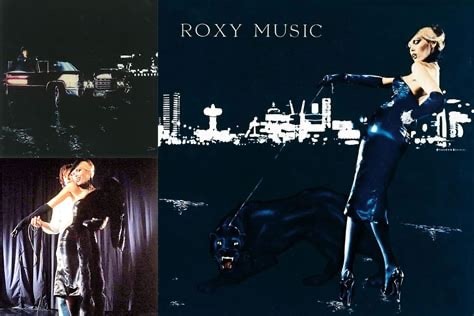
Too Strange to Be Anything But Itself: Roxy Music, a Genre of One
Not a greatest-hits list. These are the six Roxy Music songs that shaped me, from the Eno-era chaos of the early records to the one my mom played when I was a kid.
Let me get this out of the way up front: I'm not going to try to make Roxy Music heavy. I'm not going to stretch some riff into a doom connection or argue that a saxophone counts as distortion. Roxy Music doesn't need to be heavy. Roxy Music needs to be its own genre.
Sure, at the time they got lumped in with glam, and you could squint and say somebody else sounded a bit like them. But not really. Nobody else was putting a crooner in a tuxedo in front of a synthesizer making noises like a dying spaceship, with an oboe and a saxophone fighting for space behind him. There's Roxy Music, and then there's everything else.
How I found them
I was six or seven when Avalon came out, and "More Than This" was coming out of my mom's music. I didn't know who it was. I just knew it sounded like nothing else in the house, soft and shimmering and sad in a way I couldn't explain yet. That record defined a little piece of the '80s, pointing everything toward that smooth, atmospheric sound that so many bands chased afterward.
From that point on I had one mission: figure out who the hell this band was. I didn't go balls deep into every record right away. I was six. But somewhere in me I knew this band would come back around, and it did, all through my youth and still today. That one song was a door into everything that came before it, and I've been trying to drag people through that same door ever since.
Nobody gets early Roxy
Most people know Roxy Music as the smooth, late-night band of Avalon. That's real, and it's great. But I don't think a lot of people get early Roxy Music. The first records are beautiful and loud and obnoxious and strange, all the things that make music wonderful, sometimes inside the same song.
A lot of that strangeness is Brian Eno. He was only in the band for the first two albums, Roxy Music (1972) and For Your Pleasure (1973), and he barely played a conventional note. He treated the synthesizer and the tape machine like instruments of chaos, bending everything the rest of the band played into something alien. The man is a genius, and those two records are the proof.
And none of it works without Bryan Ferry. He wrote the songs and sang them like a lounge singer who'd wandered into the wrong century. Ferry was the glamour, Eno was the chaos, and the tension between them is what made those first two records explode.
Oddly, I think Eno only being there for two albums makes them stronger. They're a lightning strike, not a long career. It would have been amazing if he'd stayed, and I'll always wonder what a third or fourth record with both of them would have sounded like. But maybe it happened the way it was supposed to. Eno went off to invent ambient music and change everybody else's records, Ferry steered Roxy toward Avalon, and the world got both.
The six
Five of these come from the first three records, Roxy Music, For Your Pleasure and Stranded. The sixth comes from Avalon, their last. That's not a knock on Country Life, Siren, Manifesto or Flesh and Blood. I love those songs and those albums. These are just the six that hit me hardest.
"In Every Dream Home a Heartache" (For Your Pleasure, 1973)
One of my favorite guitar solos of all time. The song is a creepy, deadpan love letter to an inflatable doll, all hush and menace. Then it fades out like it's over, comes roaring back, and Phil Manzanera tears the whole thing open. It's a jump scare and a release at the same time.
"Virginia Plain" (single, 1972)
The first thing most people ever heard from Roxy Music, and what a way to introduce yourself. It's under three minutes of pure nerve: Ferry yelping, Eno's synth squealing, the band careening from idea to idea with no chorus to land on. Then it just stops dead on the title. No fade, no apology.
"For Your Pleasure" (For Your Pleasure, 1973)
The title track closes the album by slowly falling apart. The band drifts off, Eno's tape treatments take over, and the song dissolves into echo and noise. It's the sound of Eno's era of the band walking out the door, and it still gives me chills.
"Psalm" (Stranded, 1973)
Around eight minutes of Ferry singing what is basically a hymn, completely straight-faced. It builds so slowly you don't notice it happening, until you're in the middle of something huge. It's the most sincere song they ever made, and that's what makes it so strange.
"A Song for Europe" (Stranded, 1973)
Skip to 3:42. That's where the greatest saxophone moment in rock and roll comes in. It's not really a solo in the traditional sense. Andy Mackay doesn't trade licks or show off. He just gets loud and obnoxious, blaring over everything, and it sounds unlike any other saxophone you've ever heard. I'll argue that with anyone. Ferry is wrecked, singing about a lost love across a continent, and then the sax barges in and says everything he couldn't.
"More Than This" (Avalon, 1982)
The one that started it all for me. It's the polar opposite of the early records: no chaos, no noise, just a band that learned how to float. It's proof that the same group that made the wildest art rock of the '70s could also make one of the most gorgeous pop songs ever written.
Go listen
Start with For Your Pleasure, front to back, loud. If it sounds wrong, good. Stay with it. Then go to Avalon and marvel that it's the same band. I've spent my whole life trying to get people to hear what I heard as a little kid. Consider this my latest attempt.