Rage Against the Machine
By Ryan Montgomery·October 2026·8 min read

Rage Against the Machine came together in Los Angeles in 1991 from four musicians who had each nearly made it somewhere else. Guitarist Tom Morello, a Harvard graduate in political science, had played in the hard rock band Lock Up, which had been signed and then dropped by a major label. Singer Zack de la Rocha had come out of Inside Out, a hardcore band rooted in straight-edge politics that put out one album before breaking up. Bassist Tim Commerford was de la Rocha's childhood friend, and drummer Brad Wilk had tried out for Lock Up without landing the spot. Together they fused hip-hop, funk, punk and metal into something nobody had quite heard before.
They moved quickly. Within months, they had recorded a twelve-song demo cassette, dubbed the copies themselves and sold them for five dollars at shows. The cassette's cover featured newspaper clippings of the stock-market pages with a single match taped to the insert. Seven of its twelve songs would carry over directly to the debut album, so by the time the band went into the studio, the arrangements had been road-tested for nearly a year.
The band's politics were explicit, and they were wary of a major label. But Epic, part of the Sony empire, gave them what they wanted. As Morello put it, "Epic agreed to everything we asked." By January 1992, they had a deal. The insert of their demo had declared that no samples, keyboards or synthesizers had been used on the recording, and that proclamation would carry over to everything the band did.
Recording during the riots
The album was tracked in April and May 1992, mainly at Sound City in Van Nuys, with overdubs and additional sessions at Industrial Recording in North Hollywood and Scream in Studio City. The producer was Garth Richardson, a Vancouver-raised engineer who credited himself on the sleeve as "GGGarth" and who had worked with the Red Hot Chili Peppers and L7. Andy Wallace, who would mix Nirvana's Nevermind the same year, mixed the album.
The timing was extraordinary. Recording began just as Los Angeles erupted in riots after the acquittal of the police officers who had beaten Rodney King; Sound City sat about fifteen miles north of where the National Guard was being deployed. For a band whose songs attacked police brutality and racism, the city burning outside the studio was not background. It was the subject.
The sessions themselves were focused and efficient. The band knew its songs inside out, and Richardson concentrated on capturing their live power with clarity. Sound City's famously dead drum room gave Brad Wilk's drums a tight, punchy sound, and the album's production was so clean and dynamic that audiophiles would later use it as a reference recording.
No samples, no keyboards
The album's most striking element is Morello's guitar. Rather than use samplers, which hip-hop producers relied on, he created strange, unearthly sounds using only his guitar, amplifier and a handful of pedals: a whammy pedal pushing notes up an octave, a toggle switch flicked on and off to create stuttering, scratching rhythms like a DJ, and unconventional techniques that made his guitar sound like sirens, turntables and machinery. Under the riffs, Commerford and Wilk lock into deep, funky grooves. De la Rocha raps with furious precision, building to screamed choruses.
"Bombtrack" opens the album with a slow, menacing groove that explodes into a full-force assault. "Killing in the Name," released as the first single, became the band's defining song: a slow-building attack on police racism whose lyric is only a few lines long and ends in a furious, profane refusal repeated over and over. Epic, remarkably, released it uncensored. "Take the Power Back" attacks the education system's version of history. "Bullet in the Head" targets media manipulation. "Know Your Enemy" features a guest vocal from Tool's Maynard James Keenan. "Wake Up" ends with a passage about the FBI's COINTELPRO program, and "Freedom" closes the album with a fierce, chanted climax tied to the case of Leonard Peltier.
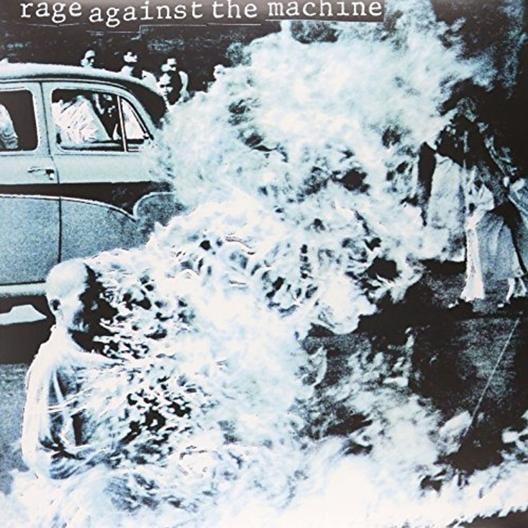
The cover was as confrontational as the music: the 1963 AP photograph by Malcolm Browne — which won the Pulitzer Prize — showing the Vietnamese Buddhist monk Thich Quang Duc immolating himself at a Saigon intersection in protest against the South Vietnamese government's treatment of Buddhists.
Lollapalooza
The album was released in November 1992, and at first it sold slowly, around 75,000 copies by mid-1993. Then came Lollapalooza. The band's performances on the 1993 tour were ferocious, and at the Philadelphia date they staged one of the most famous protests in festival history, standing naked on stage in silence for fifteen minutes with duct tape over their mouths to protest censorship by the Parents Music Resource Center. By the end of the year, the album had sold 400,000 copies in the United States.
It peaked at No. 45 on the Billboard 200 and topped the Heatseekers chart for new artists, and it reached No. 17 in the UK. It went on to sell several million copies. Critics were enthusiastic from the start.
Legacy
The album's influence was enormous. It laid much of the groundwork for nu-metal and rap rock in the late 1990s, though few of its imitators shared its politics, its musicianship or its anger. Q named it one of the fifty heaviest albums of all time, and Rolling Stone placed it on its list of the 500 greatest albums.
It has also had a remarkable afterlife. In 2009, a Facebook campaign to stop a TV talent show winner from taking the Christmas No. 1 spot in Britain sent "Killing in the Name" to the top of the UK chart, seventeen years after its release. In 2023, Rage Against the Machine were inducted into the Rock and Roll Hall of Fame.
Why it still matters
Few debut albums have been as fully formed. Rage Against the Machine arrived with a sound, a message and a purpose, and they never compromised any of them. The album proved that heavy music could carry serious political content without losing its power, and that the energy of hip-hop, punk and metal could be fused into something new.
It also proved that a guitar could still sound like the future. In an era when sampling was transforming popular music, Morello made his instrument do things nobody thought a guitar could do, using nothing but his hands, his amp and his imagination. More than thirty years later, the album still sounds furious, urgent and alive.
Essential tracks
"Killing in the Name" · "Bombtrack" · "Bullet in the Head" · "Freedom"
The views expressed in this article are those of the author and do not constitute fact, professional advice, or the position of any third party. Mythic Heavy LLC makes no warranty as to the accuracy of any statement or claim contained herein. Where this article references substance use or personal struggles, such references are drawn solely from statements made publicly by the individuals concerned. The authors of Mythic Heavy make no allegations against any person discussed on this site.